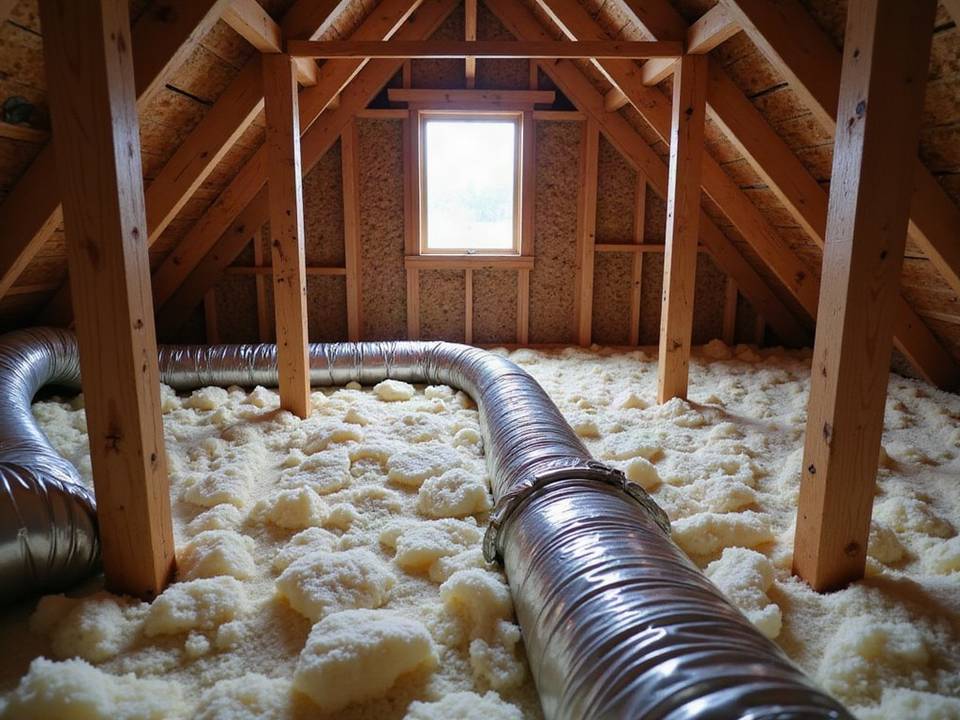
Wichita Falls and the rest of Wichita County fall in climate zone 3. For homes in that zone, ENERGY STAR’s retrofit chart calls for R-49 in an attic that has no insulation, and an added R-38 when 3 to 4 inches are already there. Floors over unheated space are listed at R-19.
Those numbers give you a clear target. This guide covers what they mean in real inches, how to see where your own attic stands, and why a home on the Texas side of the Red River needs insulation that works in July and in January.
R-value in plain terms
R-value tells you how hard a material resists heat flow. A higher number means slower heat movement. Different materials hit the same R-value at different depths, so the inches you need depend on what goes in.
- Blown in fiberglass: about R-2.2 to R-2.7 per inch
- Blown in cellulose: about R-3.2 to R-3.8 per inch
- Fiberglass batts: about R-3 to R-4 per inch
- Open cell spray foam: about R-3.5 to R-3.8 per inch
- Closed cell spray foam: about R-6 to R-7 per inch
The manufacturer prints a coverage chart on every bag of loose fill. It shows the settled depth for each R-value. A good crew follows that chart and staples depth markers to the framing so you can confirm the result yourself after the job.
How deep is R-38 or R-49?
For blown fiberglass, R-38 often lands in the range of 14 to 16 inches of settled depth, and R-49 needs noticeably more. Cellulose gets there with fewer inches. Plenty of older houses in Wichita Falls still have a thin, packed layer from the day they were built, sometimes only a few inches deep. If that sounds like your attic, you are well below either target.
Checking your attic yourself
- Choose the right day. A Wichita Falls attic in August can be brutally hot by midmorning. Go up early on a mild day with a flashlight, gloves and a dust mask.
- Walk only on framing. Keep your weight on the joists or a plywood walkway. The ceiling drywall will not hold you.
- Scan the surface. If you can see the tops of the joists poking through, the insulation is too thin.
- Measure a few places. Push a ruler straight down to the ceiling near the hatch, in the center and out toward the eaves. Note the shallowest reading.
- Look for gaps and dust trails. Dark streaks on the insulation often mark spots where air is moving through from the house. That points to leaks worth sealing.
Why this climate asks for more than average
North Texas summers routinely push past 100 degrees, and the sun on a dark shingle roof turns the attic into an oven. With thin insulation, that heat radiates down through the ceiling all afternoon and well into the night. Your AC runs longer and the back bedrooms stay stuffy.
Then winter arrives with a blue norther. Temperatures can fall hard in a few hours behind a strong north wind. The same thin attic layer that let heat in during summer now lets your furnace heat escape upward. Good attic insulation pays you twice a year here, which is the whole idea behind our guide to insulating for hot summers and cold winters.
The best fix depends on the house. Many homes need a straightforward blown in attic top up. If your ductwork runs through the attic, a radiant barrier may help, since the U.S. Department of Energy notes that radiant barriers are more effective in hot climates, especially with cooling ducts in the attic. Some homeowners choose spray foam at the roof deck to bring the attic and ducts inside the conditioned space, which should be planned together with the HVAC system.
Seal first, then insulate
The Department of Energy says to seal air leaks and make roof repairs before insulating. Loose fill insulation slows heat, but air moves right through it. Openings around light fixtures, plumbing stacks, wiring holes, the attic hatch and the top plates of interior walls let attic air and fine dust drift into your rooms.
In a windy place like Wichita County, those leaks get pushed harder than they would in a calmer climate. Sealing them first makes the new insulation perform as rated. Our post on wind, dust and air sealing goes into more detail.
When the old layer has to go
Piling new insulation on top of a problem only hides it. Plan on removal first if you find:
- Insulation that got soaked during a hail damaged roof leak
- Mold on the insulation or the roof decking
- Rodent nests, droppings or tunnels
- Lingering smoke odor or other contamination
Our insulation removal service clears the attic so the cause can be fixed and the new material starts clean.
Quick recap
- Zone 3 target: R-49 for an empty attic, or add R-38 over 3 to 4 inches of existing insulation.
- Floors over unheated space: R-19 per ENERGY STAR.
- Joist tops showing means the attic needs more.
- Seal leaks and repair the roof before adding insulation.
- Ducts in the attic? Ask about a radiant barrier or roof deck foam.
To understand what shapes the price of this work, see our guide to insulation cost factors. We serve homes in Wichita Falls, Burkburnett, Iowa Park, Electra, Henrietta and Holliday.
Not sure how your attic measures up? Schedule a free attic inspection and we will check the depth, look for leaks and damage, and give you a written plan to reach the right R-value.